Categories
Language use

You Are You

“Today, you are you,” Dr. Seuss sagely told us. Seems axiomatic enough.

Or does it? “You” is such a little and usually unnoticed word. Its context seems narrow enough, but it has caused much discussion and argument. Its use sometimes makes our language unclear. Attempts to clarify often make people feel angry or, worse, uncomfortable, or, worst of all, invisible. The problem is simple: we have one word that functions as both singular and plural. The solution, however, is far from simple.

The problem isn’t new. It probably began when English speakers stopped using “thou,” which was once reserved for the singular form. That big change didn’t exactly happen yesterday, so you’d think we English speakers might have dealt adequately with it by now. But no.

Because the single word, “you,” functions as both singular and plural, it follows that this could cause at least occasional confusion. Imagine a group situation where the speaker says something benign such as I would like you to jump up and down while imitating a wombat. If the speaker is looking directly at an individual, that could be interpreted as addressing ONLY that individual in a room that is full of people. Easy enough. But what if the speaker just HAPPENS to be looking in the general direction of one person. Then, there’s that inevitable awkwardness of having to say, Oh, no, I meant ALL OF YOU, NOT JUST YOU (along with awkward pointing, not to mention the poor, lone wombat imitator).

This is a gap in English that clearly needs to be filled, yet resistance to that filling continues without an end in sight. There is no shortage of discussion on the matter and most people agree that English NEEDS a way to easily refer to ALL of you, not just ONE of you. How can it be that everyone agrees on the need, but can’t agree on the solution?

Most people living in the southern portion of the United States have had a good solution for a very long time. “Y’all” (or even “You all”) works well. Perfectly well. I like it so much that I, a northerner, went through a long period when I tried to incorporate it into my regular usage. It worked for me. I knew that I was making myself clear in that regard. That ended when I was mocked by a person from the south who implied that I was both appropriating and condescending. A colleague of mine (a northerner, but a longtime resident of the south) also used “y’all” regularly in her classes. Reactions to the usage often showed up in her course evaluations as a strong negative. Her students thought it was “weird,” “stupid,” “odd,” “pretentious,” and a few other things. So, okay, as useful as it is, northerners can’t use “y’all.” Too bad. It’s easy to say, has all familiar parts (“you” and “all”), and easily indicates the plural.

What about “yous,” “youse,” or “youz”? The meaning of these is clear, and the familiar pluralizing morpheme (“s”) is right there. Go ahead. Try using one of these anywhere other than a few mid-Atlantic states in the US. While we’re thinking about that region, I should mention “you-uns,” and “yinz” which I hear are regularly used in Pittsburgh to indicate the plural. I can’t confirm it. I can, however, confirm that all of these words are considered to be regionalisms and, therefore, as unlikely to catch on with the general population as “y’all.”

Other proposals include “(you) people” and “(you) folks” as plural forms of address. These remain very unpopular choices. “You people” carries much bigoted baggage with it; “people” is often heard as too authoritative and patronizing; and “folks” seems, well, too folksy. In my opinion, these choices make “y’all” sound pretty good by comparison.

There is one phrase that some believe to be the solution to the problem. It has been around a long time and has been the source of much discussion and controversy. The term, “you guys” has wormed itself into the language and is considered by many (by no means by all) to be gender-neutral and perfect to fill this plural “you” gap. For some speakers, the use of “you guys” has become the natural way of speaking. Those speakers likely do not intend it to be exclusive to males even though the word “guy” has designated a male ever since Guy Fawkes (who was, in fact, a pretty bad guy). According to Alan Metcalf in his The Life of Guy: Guy Fawkes, the Gunpowder Plot, and the Unlikely History of an Indispensable Word, the history of “guy” (long a synonym for “man,” thus begging the question) makes it a likely candidate for an actual NEW pronoun to be added to the language. Metcalf claims that, in the singular, “guy” remains exclusively masculine, but takes on a more neutral meaning in the plural. He describes it as an informal version of “Ladies and Gentlemen.” He further points out that a stylized mask of Guy Fawkes has become the symbol of the Occupy Movement, certainly not specific to males and so, he claims, supports the gender-neutral usage.

A substantial portion of the population cries foul here. The history of the word does not, in fact, include females. Plain and simple. No matter how many people use it and don’t MEAN to exclude females, many females FEEL excluded when addressed as “You guys.”  It doesn’t matter if the group being addressed is exclusively female or mixed gender. If the specific audience meant to be INCLUDED feels EXCLUDED, I hope you’ll agree the solution has not been found even if the speaker has no intent of sexism or exclusion.

English still needs a good, lasting form of plural “you,” a way to address a group of people easily and naturally without offending any member. It must be gender neutral, formal as well as informal, and not attributable to a specific region. This has been a topic of discussion for YEARS, and no satisfying solution has emerged. What rolls easily off the tongue of some speakers blares in the ears of some listeners. We are obviously far from a solution. Some have proposed the invention of a whole new word. We discussed earlier that new, invented words historically have a very short life, when they arise in a closed, narrow category of words such as pronouns.

In addition to “y’all,” and for whatever it’s worth, I have a personal soft spot for “yous.” It feels good. It easily rolls off the tongue. There’s no way it can be construed as gender-specific and no way it can be mistaken as singular. I can get over the regional feel. Anyone with me?


Categories
Language use
Categories
Language use

What’s your Pronoun Problem?

To paraphrase an old (and bad) joke, pronouns are much more than nouns that have lost their amateur status.

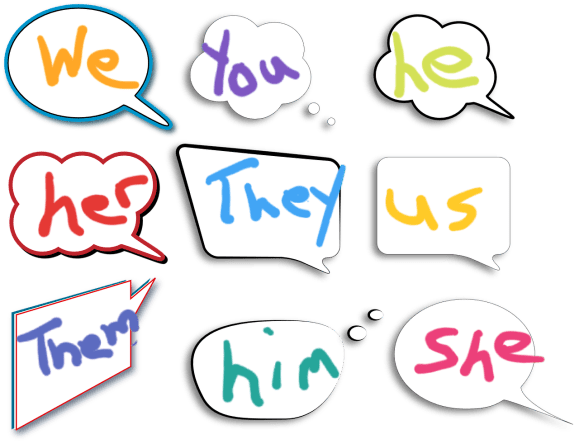
Pronouns are stand-ins for nouns. They are words that help us to avoid repetition in English by referring to a previously-named person or thing. It’s pretty hard, if not impossible, to speak in English (or most other languages) without using a lot of pronouns. Let’s face it. Saffron was just arriving for Saffron’s appointment when we saw Saffron is both clunky and unnatural. Saffron was just arriving for her appointment when we saw her is obviously a more normal-sounding sentence. Of course, natural language is not always as simple or straightforward as we might like it to be. Pronoun use, while necessary for clear language, is receiving a great deal of attention lately.

As a cisgender person, I don’t presume to know what it’s like to be designated by a pronoun that doesn’t describe how I feel about myself. But I certainly respect those for whom “he” or “she” fail to be adequate or accurate.

The accepted current option is “they” in the singular. Many people say they don’t like this option although the reasons I’ve heard are really about the speaker not feeling comfortable with a new use of an old word.

We simply must get over that if we’re going to have any kind of conversation about the usage. If someone wants to be designated by the pronouns “they” and “them,” that is that person’s choice, and I damn well intend to respect it. I hope you will, too.

But why is this usage so uncomfortable for some? Good question with a lot of potential answers. One answer comes from an attitude that there are two well-defined genders and “that’s just the way it is.” This is an unsatisfactory response that begs the question and has nothing to do with grammar, so I’ll move on from there. Everyone isn’t the same.

Another answer is that it just feels weird if we’re using “they” in the singular. Well, until we come up with a long-needed, gap-filling, gender-neutral singular pronoun in English, which many have tried to do, our options are surely limited. Gender identification notwithstanding, no one even likes the “he or she” option in formal writing, much less “him/her,” ” s/he,” or, worst of all the self-conscious alternating of “he” and “she” in a text. As much as humans enjoy making up new words, we seem to be quite reluctant to use new words that others tell us to use.

Many have (legitimately) asked about verb agreement. Should we say “they are” even if we’re talking about one person, or should we attempt to introduce “they is”? I seriously doubt that would catch on. We’re not savages. And, like many, I struggle with the word, “themself.”

Before we go off the rails talking about this “brand new, novel” usage of “they” in the singular, though, let’s stop and think about it. I submit to you that it is NOT brand new or novel at all. We’ve been using it for as long as most of us can remember. We’ve been using it easily, comfortably, and regularly. Perhaps we have not been using it formally, but the formal often follows the informal vernacular. Language evolution can be a very democratic process.

So, how exactly were we using “they” in the singular? Try this one: Someone called earlier, but they didn’t leave a message. Okay, admittedly, this might give a grammarian the shakes, but come on. We say things like this all the time without hesitation. How about when we’re enjoying some minor road rage because Did you see how they cut me off back there? Or I tried to return the feather boa, but they told me it looked like it had been worn.

My point is that we have precedent for using the singular “they,” and if we’re a little squeamish  about it as a formal construct, the discomfort likely isn’t linguistic. According to the Oxford English Dictionary, speakers were using the singular “they” as early as the fourteenth century. Apparently, we didn’t get nervous about it until the eighteenth century when grammarians started telling us it wasn’t okay for “they” to refer to a singular. It’s all part of the odd paradox that, while language is constantly changing and evolving, we damned well want it to change and evolve on our terms and not because somebody tells us what to call them (See? You hardly even noticed that right there, did you?)

Pronouns are necessary to natural English. Period. Full stop. End of story. Why not use them to accurately refer to each individual according to their preference? (There it is again! It’s getting easier to accept, isn’t it?) We shouldn’t use the excuse of “correct” grammar as a barricade to social progress.

A final thought before saying goodbye for now. “They” is not alone among pronouns doing double duty and causing headaches. Our next topic for discussion will be “you.” Singular? Plural? Yes.

Categories
Language use

DOING Language

Hello, and welcome back!

Let’s dive right in and answer the riddle from my previous post. What word does sex, lunch, and murder have in common? I can’t think of a more appropriate word with which to begin our discussion: DO! That’s right. We DO lunch. Our crude acquaintances “DO” another person when they have sexual relations. Tony Soprano types “DO” someone” when they have absolutely the opposite of sex in mind. There are other ways that we “DO” another person: With those eyebrows of hers, she really DOES a great Groucho! That famous make-up artist said she’d DO me next.  In addition, we DO dishes, laundry, and homework. We DO our hair. We DO windows (or we DO NOT, as is often the stated case). The miscreants among us DO time. We use the word to mark achievements (I DID five miles this morning) or lack thereof (Why are they DOING so poorly?) It is a great word for disavowing: I want nothing to DO with you! We had nothing to DO with that decision.

Well, I could go on, and I’m sure many of you are thinking of a zillion other ways to use the word, DO. While you’re on it, DON’T forget (see what I did there? Oh, and there?) about DO as an auxiliary (helping) verb. In English, we have only a handful of words that can be used as both main and auxiliary verbs. Certainly, BE is one of them: Mordecai is an excellent taxidermist/Mordecai is enjoying the amazing weather. Sometimes, HAVE works the same way: Esmerelda has sixteen adorable dachshunds/Esmerelda has always loved those wiener dogs.

But DO is unique. It’s such a self-important little word that it inserts itself in places just for fun. It tags along with most other verbs (exceptions: BE, CAN, WILL, MIGHT, and a few other words that function exclusively as little helpers) as in DO you want a pickle with that? (This is about wanting, not doing.) Or No, I DO not want a pickle. It moves in and makesitself comfortable when we want to make a statement into a question: They love 1980s teen movies, DON’T they? Or when we want to emphasize something: Oh, I DO love to eat snails, DON’T you?

Sometimes, that little bugger even double dips, putting itself into a sentence twice: DO you DO the tango? DO you DO windows? I most certainly DO not DO dishes.

It certainly shows up in its share of famous slogans and encouragements: Just DO it! We can DO it! Keep practicing; you can DO it! And on it goes

What an amazing word. It’s not surprising at all that we DO language, is it?

Categories
Uncategorized

A Brief Introduction

Thank you all for being here!

Now that I have your attention, I thought I’d formally introduce myself.

I told you in an earlier post that I love everything about language, but I’m not sure if I made it clear that I am an unabashed language nerd. And proud of it.

Language has surrounded and permeated my life. I studied language in many forms–a BA in English Education from Northern Illinois University, an MA in Applied Linguistics from Penn State, and a Ph.D in Linguistics from the University of Washington. I have also studied several languages.

I taught the English language and about language for over 40 years, mostly at the university level. As a teacher, I was privileged to be paid to examine aspects of language to my nerdy heart’s content. Some of these aspects were language meaning, the social use of language, the psychology of language, the development of first and second languages, language usage, language pronunciation, language varieties, and language structure.

I researched some languages of Africa, following a stint as a Fulbright professor/scholar in the tiny country of Burundi.

In addition to these interests, I also love travel, reading, cinema, cooking (well, honestly, more eating), and pretty much everything about animals.

Now I can’t wait to get to know some of you.

My next post will be about a single word that has many meanings, many functions, a fascinating history, and is a favorite of Scrabble players. Hint: what do sex, lunch, and mob murders have in common?

Categories
Language use

DOING LANGUAGE

“We die. That may be the meaning of life. But we do language. That may be the measure of our lives.”

Toni Morrison

I did language for a living as well as for a pastime. I did language in a big way. I studied it. I taught it. I researched it. I analyzed it. I did all of this because I love language. I do. Sure, I got the required credentials to teach linguistics at the university level, but that was because I loved talking about language, thinking about language, reading about language, writing about language, and arguing about language.

It seems that I still love to do these things, but I no longer have captive audiences whose tuition dollars keep me honest (as well as fed and sheltered).

So, I decided to provide myself with the audience and interlocutors for my thoughts, observations, questions, and analyses of and about language use throughout my world. To paraphrase and butcher an old saying, I guess you can take the woman out of linguistics, but you can’t take the linguist out of the woman.

This blog is for all of my present friends and all of my future friends who talk, write, teach, argue, joke, play, and analyze. It’s for anyone and everyone who does language. Please join me.

Some of the entries will be short, and some a bit longer. Some may be a bit more serious than others. All of them will reflect my thoughts on language.