
It has been a very long time since I’ve added a posting to this blog. My reasons are many, but they will all sound like excuses. I apologize to all of my fans and supporters; I would never want to disappoint the five of you. That said, I continue to work on two essays regarding the framing of political discourse and textualism in interpreting the US Constitution. As you might imagine, there is a lot to say on these topics, and there are new things to add every day. Every hour of every day. I think that will be the case for a long time to come.
Rather than wait until I finish, I realize that I have plenty to say about a multitude of language topics. As I told you from the beginning, it seems that I am never NOT thinking about language. I thought I’d share with you some very random linguistic musings that have wandered into and through my brain recently as musings will. I have divided my thoughts into three marginally-related categories for now: words and phrases I hate that no one else seems to hate, weirdly interesting ambiguities, and odd-sounding translations. I despise language pedants, so, while trying not to sound like one (I know, I know, too late for that), I’ll limit myself to just a few in each category. Meanwhile, welcome to my head.
Let’s get the negative energy out of the way first. Everyone has words and phrases that they can’t stand. I get that. Sometimes, there’s no particular reason for the dislike. Some people hate the sound of a particular word. Moist seems to be one that evokes a strong reaction in many people, and there’s some scientific backing to that negative reaction. Without getting into too much detail, suffice it to say that people had a MORE disgusted response when classically attractive people used the word in varying contexts than they did when the same people talked about a delicious piece of cake. For many, certain sounds evoke a physical response. Some people hate clichés because of how played out they are or how unoriginal. Some people have no reason whatsoever to detest some random aspects of language use. I’ve already revealed that I can be one of those language-intolerant individuals. Today, I’d like to extend my previous set of linguistic pet peeves to a few words and phrases that are widely used and grammatically correct in any system, but just rub me the wrong way.
There’s a common expression meant to indicate that a victim was random and did nothing to bring a calamity on him or herself. I understand the expression and its intent. I know what people mean when they say it. But I still can’t stand the phrase, “He/she was just in the wrong place at the wrong time.” I find it interesting that I, personally, can understand one thing but hear another. I understand, as stated, the intent. I hear, that person should not have been in that place at that time. I still hear blame. I KNOW! No one is truly blaming the victim here. What can I do? Absolutely nothing except not use the phrase and keep quiet when others do.
Along similar linguistic lines, another common phrase I despise is agree to disagree. Yes, I get it. The discussion has gone on too long. We will never come to an agreement. We don’t want to have bad feelings remaining. I absolutely get it. But I still hate it. I hear something different: I’m right and you’re wrong so I’ll be the bigger arguer and let you think we’re equal. This phrase has an extremely long history in English. It has been around at least since the 18th century although there is no agreement as to its first documented usage. See what I did there?
The last one in this category is one I’ve struggled with for decades. I absolutely understand that the person saying it is extremely well-meaning and would be shocked to receive a negative response. I GET IT, so no lectures. But, please, oh puhleeze, DO NOT tell me that you are proud of me unless you had something to do with my accomplishment or, at least, unless we have a close relationship. I have cringed in silence so many times over the years when a random person has told me he or she is proud of me due to something I’ve done or accomplished. Again, I get it. It is meant kindly. But I hear condescending and patronizing. I’m happy to say that, while this is not, perhaps, the feeling of everyone, I am not alone in it. Ben Casnocha, author and entrepreneur, laid it out nicely in a 2010 article. I didn’t need validation on my feelings on this one, but it’s always nice to get it. Casnocha points out that it’s simple. A person expressing pride in another should be of higher rank or status, thus implying that the “proudee” has somehow followed successfully in the footsteps of the “prouder.” Or, absent that relationship, the two people must know each other well. My parents could be proud of me. My husband could be proud of me. My mentor could be proud of me. My student really couldn’t. My neighbor, not so much. A casual acquaintance? Nope. I have had a lot of disagreement over the years on this. If you disagree, know that you will not change my mind. We’ll just have to, well, you know. Please see above.
The next category might not even count as a category. Let’s call it a subset of the previous category. As such, I’ll keep it short. I guess these can be called clichés that are really too young to be clichés. Probably better to give you an example or three. I personally cringe when someone uses the expression, “drink the kool aid” as in “Wow, those cult members really drank the kool aid, didn’t they?” It’s not creative language because that is literally what happened! Cult members drank poison kool aid because their cult leader told them to during the 1978 Jonestown Massacre. YES! I get what it means! Please don’t feel you need to explain it to me. I’ll still cringe whenever I hear it because every single person who says it thinks it’s the first time anyone has said it. Same with anything ending in –gate to indicate a political scandal. The Watergate was the hotel at the center of Nixon’s political downfall, and, since then, any political scandal has mis-analyzed the “-gate” part of Watergate as a productive morpheme (one that language users continue to use with new words as when we add –s to indicate the plural of a new noun). The really maddening thing is that, no matter how much I hate it, it’s working! The misanalysis has given rise to so many new words for political scandals (really, mostly non-scandals) that it has almost become a part of the language. Generations from now, students will learn the origin of the ending in linguistics classes and be happy to share the newfound knowledge at parties and family dinners (notice how I assume students will still study linguistics generations from now?). Finally, and I know I’m not alone in this, I cringe anytime someone says “Guns don’t kill people. . . .” Duh. I just can’t with this one. Fortunately, no one I spend any significant amount of time with would say this.
Switching gears rather unceremoniously now. My next category of musing involves some weird ambiguities that I’ve noticed lately. I guess I’ve always noticed these sorts of things, but I think the Covid lockdown has given me more time for extended thought. I’m not talking about the often-discussed systemic ambiguities in English that commonly occur with some ordinary subordinate phrases as in I saw the dastardly thief with my telescope (who’s got the telescope?) or Maribell got a bath ready for her Pomeranian wearing a chartreuse tutu (who’s wearing the tutu?).
Here’s a new one for me. The New York Times online version had, until very recently, a section in the weekend edition called “Have You Stayed Up To Date This Week?” Fully cognizant of their concern as to whether I’ve kept up with the news, I continued to choose to think of it as I originally read it: asking me if I have lost sleep by going out with romantic partners this week. Have I stayed awake to do this? I think I must not have been the only person with this idea because the NYT recently changed this section’s title to something less ambiguous, “Did you follow the headlines this week?”
I recently came across an online ad for a Free Will Kit. Sure, I understood they were going to send me a template for an estate plan, but I couldn’t help but wish there was a kit that would give me free will or, at the very least, a kit that would teach me philosophy. I even found myself imagining the Ikea-like set of instructions included with the kit. As long as I’m on the subject, why not add here all of the hundreds of other ambiguities built into the language—things such as horse doctor, pig farmer, and child psychologist. No such list would be complete without including my absolute favorite film title, the 2009 Lesbian Vampire Killers.
I’ll end these random musings with a couple of interesting translations. In my current country of residence, English is widely used. The English used was originally an offshoot of British English, but has further branched into its very own dialect. One of my favorite almost-the-sames is the language used for anything buffet style. American English tells us that it includes “All you can eat.” Here, the phrase is “Eat all you can.” For the life of me, I can’t figure out why that one stops me and amuses me when the phrases use the same words just in a different order. Yet, even as I write this, I’m smiling.
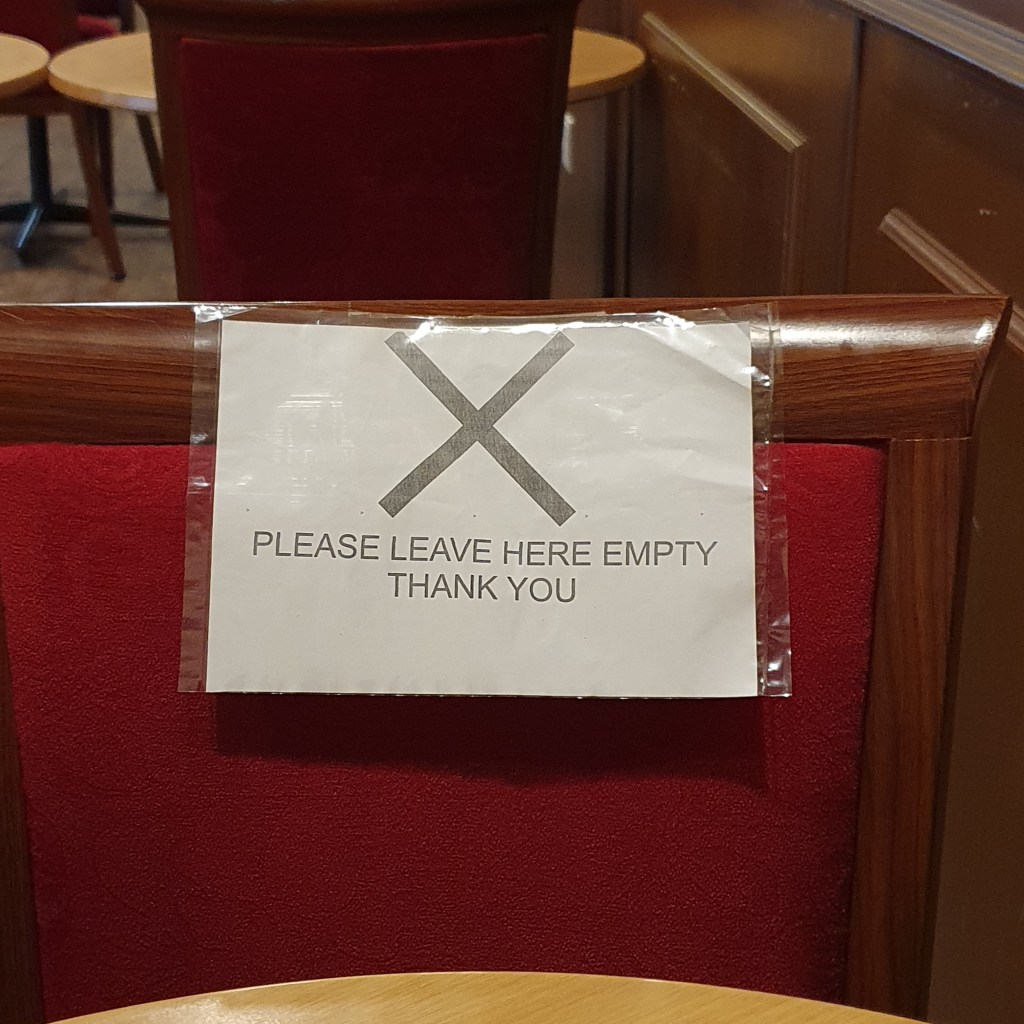
Finally, an example unique to both my country of residence and the current health crisis that has swept the world. Restaurants are trying hard to stay at no more than 50 percent capacity. To that end, many are designating seats at tables that are to remain empty. I truly believe that one restaurant did NOT intend the meaning I initially interpreted from the sign over these empty seats: “Leave here empty.”
I’m sure you can come up with countless others. What normal, everyday linguistic characteristics or phrases amuse you? Annoy you? I’d love to hear them.






 DOING LANGUAGE