
Bad puns and silly elementary-school jokes. Whatever you call them, we all know these little one-liners or question/answer combinations because we have all grown up with them. They change a little with the times, but many that are told today are the same ones that I heard and told as a child. Sometimes, there are multiple variations. Nowadays, the favored term for these jokes is “Dad jokes.” Why does Dad get the credit? Maybe because Dads, from the beginning of time, seem to have the dual goal of entertaining and embarrassing their children. Reaction is important. The teller is going for an eye roll or a groan. If you get both, you’ve achieved the dumb joke jackpot. Add an exclamation of disgust and you’ve achieved the lowly-humor trifecta.
One of the most important characteristics of these jokes is that they are relatively inoffensive. I realize that’s subjective, but these jokes are what’s left when you eliminate race, sex, ethnicity, age, and sexual orientation or identity before telling the joke. And kids get them. That’s one of my key points here.
Kids, even very young ones, get these jokes and also delight in telling them. How is it that kids everywhere, generation after generation, get these jokes? One of the very first questions that must be covered when studying language, in fact, the first question of many linguistics courses, is “What do we know when we know a language”? What does “knowing” a language entail? Basically, “knowing” a language means being able to get stupid Dad jokes although it’s just a tad more complicated than that. At a very young age, the acquisition of our first language is complete. Sure, our vocabularies increase and our abilitiy to understand complexities increases, but our basic knowledge of our language is pretty much intact by the time we reach 6 or 7 years old without having to be taught.
I used to try to begin each class with one of these silly jokes to make a point about intuitive linguistic knowledge. This basic knowledge of our language—the things we KNOW when we say we “know” a language are exactly the same things that allow us to understand jokes. Let me give you a few examples.
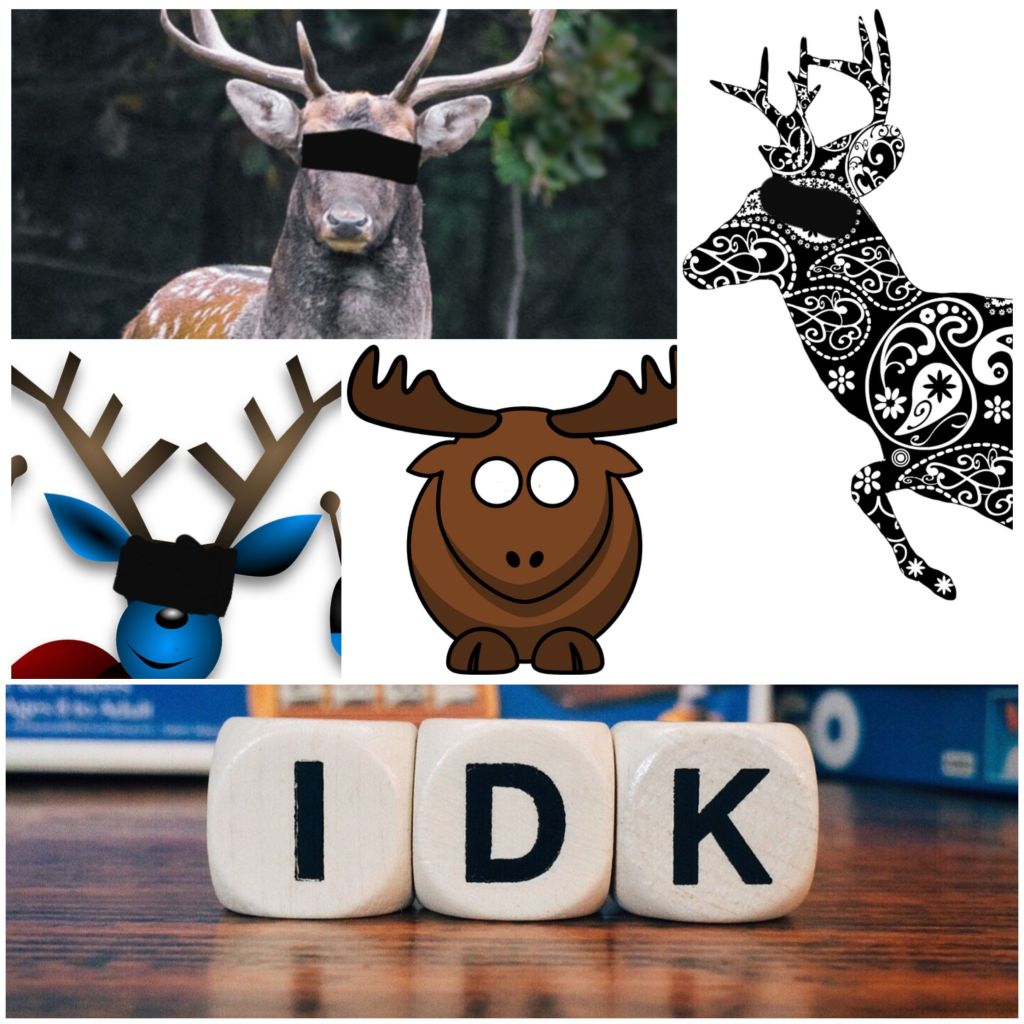
What do you call a blind buck? No eyed deer!
Remember that one? I remember telling it and thinking it was hilarious. What a terrific play on words! How can every kid get this joke? When you think about it, it’s pretty sophisticated. One of the first things we know when we know a language is the phonetics and phonology of that language. That is, we understand intuitively what sounds the language possesses and what combinations of sounds are permitted in the language. For example, an English-speaking child in North America, Australia, or England doesn’t have to acquire the click sounds of Southern African languages because those sounds simply aren’t employed by the child’s language so are not needed in the language tool box. The joke about the poor deer depends on our knowledge that some dialects of English employ the “r” sound in the middle and at the end of words while other dialects do not. (Those that do employ the sound are called “rhotic” dialects. Those that do not are called “non-rhotic.”) This entire joke depends on knowing this! “Eye deer” sounds the same as “idea” except for the final sound—with or without the “r”. This is one of those cases where I always got the joke, but I only realized recently that I never REALLY GOT it. It works both ways, as I discovered when I heard an Australian friend pronounce the name of a local restaurant, “The No Eyed Deer.” She pronounced it with the ending sounding like “idea”—”The NO IDEA,” thus bringing me full circle from my US, rhotic history. It’s one of the rare dialect jokes that works in both directions.
The point, of course, is that this requires no analysis on the part of a child. He or she simply gets it from the start. These are aspects of our language that we are not taught directly, but that we know intuitively, and these are the tools needed to understand these jokes.
Same joke, different set-up:
What do you call a fake noodle? An impasta.
Here are a couple bonus jokes that depend on our early-acquired knowledge of phonology, our language’s sound system:
What did the pirate say on his eightieth birthday? Aye matey!
Just one more: Did you hear about the circus fire? It was in tents.
Another basic thing that we intuitively know when we know a language is that language’s syntax or grammar. I don’t mean we know all of the school rules of course. Rather, we know the basic structure allowable in our language, and we know this at a very young age. We might not know that the phrase “the magnificent, periwinkle starfish” has the structure of article-adjective-adjective-noun, but any 5-year-old child knows that “starfish the periwinkle magnificent” isn’t English, nor is “the periwinkle, magnificent starfish.” Isn’t it amazing that we just know this stuff! Here’s one of my very favorite jokes that depends on this syntactic knowledge.
I was watching a magician walking down the street. Suddenly, he turned into a grocery store.
See what’s happening here? We “get it” because of our intuitive understanding that “turned into” can mean both “turn in the direction of” and “become.” The first one is verb+preposition (direction); the second one is a phrasal verb, a two-word verb that has a different meaning from either of its parts or even a sum of those parts. We wouldn’t expect a child to explain it, but that kid still thinks it’s funny. Because he or she KNOWS the language. And it IS funny.
Here’s a bonus joke that depends on our knowledge of syntax: A termite walked into a bar and asked, “Is the bar tender here?”
See? A “bartender” is a noun and the phrase “bar tender” is a noun+adjective (description), so it’s our understanding of English phrase structure that makes this one so funny.
One more bonus in the syntax category:
Did you hear about the kidnapping at school? It’s okay now. He woke up.
Knowing a language means knowing the “pragmatics” of that language. In the linguistic sense, “pragmatics” encompasses all that is cultural and context-driven in a language. Knowledge of pragmatics is what tells us, for example, that people ask us how we are as a conventional social greeting and not as a true question requiring a truthful or detailed response. It’s what tells us if a society is comfortable or not with certain topics. It’s what gives us the general background of a society or a group, whether it’s a cultural group, an age group, or even a group of co-workers who share inside knowledge. It allows us to understand hints and irony and implications.
My favorite joke that depends on a knowledge of pragmatics for understanding (and often takes a nanosecond for a reaction):
I ordered a chicken and an egg from the store. I’ll let you know.
Note, there is another, funnier adults-only version of this joke; it has to do with a chicken and an egg lying in bed, smoking cigarettes, both looking content. You can probably fill in the rest for yourself.
Bonus pragmatics-dependent joke: If you see a robbery in an Apple store, does that make you an iWitness?
Second bonus (because I can’t stop myself): Have you heard about the restaurant on the moon? Great food but no atmosphere.
When we know a language, we know the semantics of that language. Semantics is the study of meaning and is a vast area of study. Among its many branches is the understanding of ambiguity or multiple meanings. Very often, these Dad jokes depend on this kind of basic intuition. An ambiguity might occur merely because of a dual meaning of a single word. Sometimes, it’s as simple as homophones—words that sound the same but have different meanings. These can be spelled the same. The trio of “bear,” the animal, “bear,” to stand or abide, and “bear,” to produce has given rise to one of the most famous linguistics-class examples of ambiguity: “She cannot bear children.” Homophones can also be spelled differently, requiring the joke to be oral for it to work. One of the oldest classic Dad jokes involves the first type of homophone:
Why are there such high fences around cemeteries? Because people are dying to get in.
This one involves a different spelling so must be oral: The largest knight at the round table was Sir Cumference. He acquired his size from too much pi. (Okay, maybe a young child wouldn’t get the pragmatic part of this.)
And then there’s:
I just watched a documentary about beavers. Best dam show I ever saw!
Just one more in this category, and then I promise I’ll stop:
Atheism is a non-prophet organization.
Some semantics-dependent jokes require understanding that the same word has two possible meanings. These are not quite the same as homophones because the meanings of the words are related, so I’ll call this a sub-category of the ones above:
How do I look? With your eyes! (remember our discussion last week about the words that are both senses and actions? This one could also be in the syntax category)
Or:
Don’t ever trust atoms. They make up everything.
And, one more:
As two cannibals were feasting on a clown, one said to the other, “Does this taste funny to you?”
So, when we say we “know” a language, we’re saying so much more than that we can communicate in a language. In our first language, our intuition is massive. We know an entire textbook of linguistics before we even crack the cover. Humans are brilliant creatures when it comes to the language faculty.
I’ll leave you with one of my favorite jokes that really falls into several of the above categories. I like this joke. A lot.
Why don’t you ever see elephants hiding in trees? Because they’re very good at it!


 DOING LANGUAGE