Are you ever just angry and frustrated and feel like letting off a little verbal steam? David Sedaris, ever the astute life observer, tells us, “When s*^t brings you down just say ‘f*^k it’, and eat yourself some motherf*^king candy.”
Okay, then. While some might quibble with his delivery, there is no question of his message, is there?
It seems that almost everyone has an opinion about swearing (or cursing or cussing) and a judgment of the person who swears. Those opinions can be extreme: from uncreative, unintelligent potty-mouthed sinner to witty, brilliant, expressive wordsmith. The world notices swearing. We see that in children’s giggles and the pursed lips and punishment of teachers and parents. When you really think about it and put aside any emotional, social, or religious aversion, we’re only looking at a bunch of sounds put together just like any other word. An example I’ve often pointed to is “__uck.” It should be obvious that the intended word here is “duck.” No? Maybe “luck.” “Buck”? One single letter, which changes one single sound is the difference between a gasp and, well, nothing. No reaction at all. Why? There’s nothing wrong with the letter “F” or the phoneme /f/. It’s a perfectly appropriate beginning to “fantabulous” or “fudgalicious” among hundreds of other words that are universally inoffensive. There’s also the weird phenomenon that we “allow” substitutes such as “freakin’,” “darn,” “heck,” and “frack” without hesitation. You’re not fooling anyone!
Whatever your personal feeling, you should be aware that multiple studies, both popular and scholarly, have recently noted that swearing is often a sign of high intelligence. It also seems, according to a study at Rochester University, that intelligent people who swear a lot tend to like spicy food and like to walk around their houses naked. While not relevant to the current discussion, this combination of behaviors bears further examination. Lindsay Holmes, in a 2018 Huffpost.com article, says that people who swear just might be happier and healthier (and, obviously, more honest) than those who do not.
In many ways, we’ve come a long way as a culture regarding our views on swearing, but in other ways we’ve remained quite stagnate. In the 1950s, comedian Lenny Bruce went on trial for using obscenities. Most of his transgressions were in live clubs, not over the airways, which might have reached uninvited into the living rooms of private citizens, but that is what many remember about him to this day rather than his social and political commentary and satire. Twenty years later, George Carlin schooled us on the seven words we can never say on television. Carlin got it right (and led the US into a 1973 Supreme Court ruling on obscenity over the airwaves (FCC v Pacifica)). The only reason Carlin’s bit seems a little outdated now is that television itself has expanded to include cable and streaming platforms. We STILL, well into a new century, can’t say those seven words on network television.
Every language has swear words or ways to make words into swear words. How did the whole phenomenon of swearing come about? Very generally, cultures develop subjects that are considered taboo. Typically, these subjects include (but are not limited to) sex, death, and bathroom activities. Over time, words are invented or adopted that describe these activities in ways that shock some members of the culture. We call these words “epithets.” For every epithet, languages usually have what is called a “euphemism,” a word or phrase that, shall we say, lessens the emotional impact of the epithet. So, for every “f*rt,” there’s a “pass gas.” For every “f*^k,” there’s a “make love.” Interestingly, in English, most of our favorite swear words come from Germanic origins via Old English. Our more “genteel” or scientific words tend more often to come from Latin origins. For example, “f*^k” is likely from Old English (Germanic) while “fornicate” is from Latin via Middle English.
All of this history doesn’t really help in answering the question of why some people swear more than others or why some people dislike swearing more than others. Maybe it would help if we look at some of the different reasons for swearing. Again, this is certainly not an exhaustive list. For more detail, I recommend some of the articles written by Steven Pinker, a Harvard linguist, psychologist, and cognitive scientist, who has done many detailed studies of the subject. Here, we’ll just look at a few of the more common purposes behind your everyday, garden variety swearing.
One reason we swear is to show others just how awful we think something is. It can be a judgment, unspecified but obvious. For example, compare “Fosnick (is a fine young man who) makes love like an angel” with “(That cad) Fosnick is currently f*^king his secretary behind his wife’s back.”
Additionally, we might use a swear word for emphasis: It’s not just cold. It’s f*^king cold. It’s not just a load of work. It’s a s*^tload of work. He’s not just a bad person. He’s a mother*^king, rat bas^#rd, a**hole. See? There’s absolutely no doubt as to just how bad a person he is.
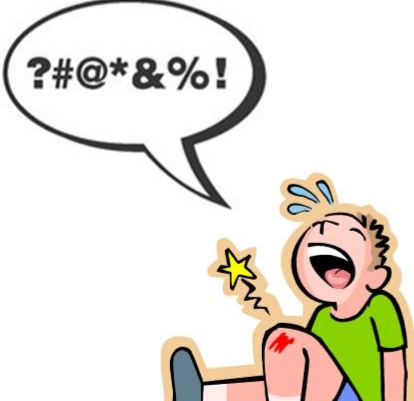
Probably the most common reason for swearing is simple catharsis. When you stub your toe or hammer your thumb, you might yell “ouch” or even “OUCH!” but it FEELS better (at least to me) to let loose with a string of obscenities that would make a stevedore proud but make your poor grandmother or a member of the clergy blush. When one is alone in the car and a brainless waste of skin cuts you off, isn’t it better to scream obscenities to yourself in your own car than to do pretty much anything else that road ragers tend to do? Of course it is. It hurts no one.
Swearing for catharsis could be more than a matter of personal preference as discovered in a recent study on swearing and pain relief. Emma Byrne, in her book, Swearing is Good for You notes that researchers thought it unlikely that something NOT useful (“maladaptive” in scientific terminology) would so often be USED to adapt. In one simple test, psychologist Richard Stephens allowed 67 test subjects one swear word and one neutral word to use when subjected to pain (putting their hands into ice water for as long as they could). It turned out that, when swearing, the subjects could keep their hands in the water for 50% longer on average than when they were using their neutral word (such as “brown” or “smooth”). While swearing, the subjects’ heart rates increased and pain perception decreased. Every time. As the testers concluded: “Maladaptive, my a^*!”
See? Swearing can be good for you. Isn’t that a f*^king relief?

 DOING LANGUAGE